

Key takeaways
- Agentic commerce optimization is the practice of writing product content for AI agents that read listings on a shopper’s behalf. The agent, not the shopper, now decides whether your product enters the consideration set.
- Every discovery surface pulls from one source: your listing. Standard search, sponsored placements, Alexa for Shopping, Walmart’s Sparky, and open web assistants like ChatGPT and Gemini all read the same fields you control.
- Amazon’s July 27, 2026 title change compressed titles to 75 characters and added a 125-character Item Highlights field. It was not a formatting update. It was Amazon rebuilding its shelf so machines can parse it cleanly.
- Ads are table stakes. Content is the new frontier. The industry spent a decade algorithmically optimizing bids, budgets, pricing, and inventory while content stayed manual, creative, and one-time.
- One content upgrade in a Teikametrics customer catalog moved conversion rate from 4.3% to 5.7%, ROAS from 5.15 to 6.33, and total sales up 70.5%. The page got better, so every dollar already running behind it returned more.
What is agentic commerce optimization?
Agentic commerce optimization is the practice of structuring product content, titles, bullets, descriptions, attributes, and backend keywords, so that AI shopping agents can read a product accurately and recommend it. It differs from traditional listing optimization in one respect that changes everything: the primary reader is no longer a person scanning a grid of results. It is a model parsing text and structured data, then returning a short answer to a shopper who never sees the grid at all.
That shift has a practical consequence. A human shopper can forgive a thin listing because they can look at your photos, read your reviews, and infer what your product does. An agent cannot infer. An agent will never invent your best feature. If a claim is not written into a field the agent reads, that claim does not exist.
Discovery is moving from human browsing to machine reading
For twenty years, marketplace discovery worked one way. A shopper typed two or three broad words, Amazon or Walmart returned a page of options, and the shopper did the filtering by scanning. The brand’s job was to win a spot on that page and then win the click.
Conversational discovery inverts that. Instead of “best wireless earbuds,” the query is now “wireless earbuds that stay in during running and have at least 6 hours of battery.” The shopper has moved the filtering work upstream, into the query itself, and handed the scanning work to a machine. Less reading, more asking.
Look at how that single query gets resolved. “Wireless earbuds” is matched from your title. “Stay in during running” is matched from your description or bullets. “6 hours of battery” is matched from a structured attribute field. Three different parts of your listing, each carrying part of the answer. If any one of them is missing or generic, you fall out of the result set before a shopper ever evaluates you on price, reviews, or brand.
This is why the fields are no longer marketing copy. To an AI agent, these fields are your product. Every empty attribute is a missed connection.
Amazon’s July 27 title deadline was a signal, not a formatting change
On June 10, 2026, Amazon announced that starting July 27, product titles in all categories except media would need to be 75 characters or less, including spaces. Most brands were running titles of 200 to 250 characters. Amazon paired the cut with a new Item Highlights field offering an additional 125 characters for materials and recommended use cases, searchable and visible in both search results and on the detail page.
The enforcement mechanism is the part that mattered most. Brands that did nothing did not keep their old titles. Amazon’s AI rewrote them, deciding on its own which keywords survived the cut. Brand-registered sellers were given up to 14 days to review AI-generated rewrites in Review Listings Changes before they went live. Sellers without Brand Registry got no review window at all. Titles already under 75 characters and policy compliant were left alone.
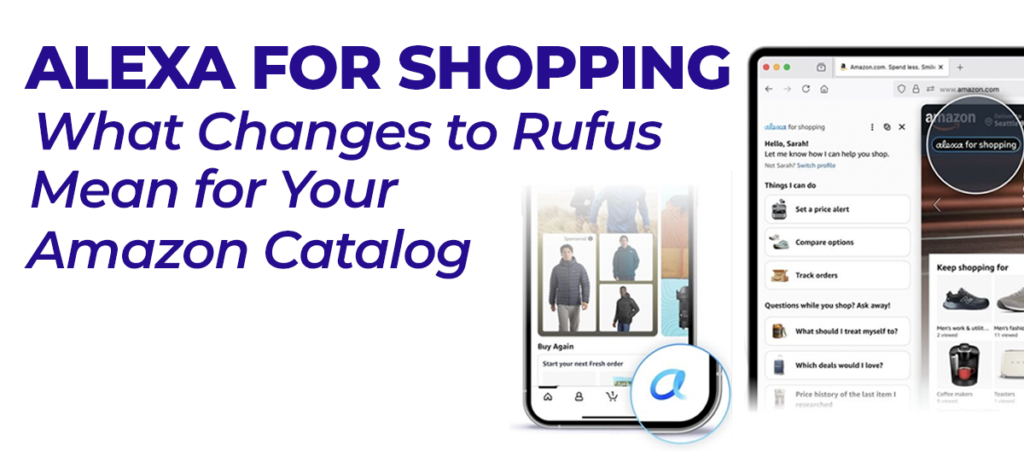
Here is why a character count is worth this much attention. The title is the first and highest-signal field an AI reads. Amazon compressed it to 75 tight characters precisely so machines can parse it cleanly, at the exact moment machines became the primary readers. Six weeks before the deadline, Amazon rebranded Rufus to Alexa for Shopping and planted its agentic commerce flag. Then the title deadline appeared on an unusually fast clock. Those two moves are the same move.
Losing your title is not a formatting problem. It is losing control of how you are found, ranked, and advertised. The title is the single strongest relevance signal for search, human and AI. Ad relevance and ROAS depend on listing-to-keyword alignment, so a generic rewrite degrades every campaign running behind that listing. And your title is your promise on the shelf. Let a model decide it, and your positioning, voice, and differentiators are up for grabs.
One catalog, four readers
The most expensive mistake in agentic commerce optimization is assuming there is one right way to write a listing. There is not. The agents do not read the same way, and a listing tuned for one can underperform on another.
| Reader | Where it sits | What it rewards | What fails |
|---|---|---|---|
| Alexa for Shopping (formerly Rufus) | Conversational layer over the Amazon catalog, plus on-page guidance | Descriptive, review-driven content. Narrative use-case language and social proof written into the listing. | Terse attribute lists with no explanatory language |
| Sparky (Walmart) | Walmart app and site, increasingly transactional | Structured, attribute-complete data. Clean fields where completeness beats storytelling. | Prose-heavy listings with empty specification fields |
| ChatGPT and Gemini | Open web, outside marketplace walls | Indexed web content and structured product feeds, not marketplace attributes directly. A third read pattern entirely. | Content that lives only inside a marketplace listing |
| Sponsored ad ranking | Inside marketplace search | Tight listing-to-keyword alignment between what you bid on and what the page actually says | Bidding on terms the listing never mentions |
Alexa for Shopping does not just influence discovery. It converts on-page. It suggests the questions a shopper should ask, surfaces the relevant detail instantly, and answers purchase questions before the shopper leaves the page. Every one of those answers comes out of your content. If your listing cannot answer “is it machine washable,” the assistant either says nothing or says it does not know, and you lose the sale inside your own detail page.
Content is the most under-optimized asset in ecommerce
We work with brands spending $5M to $10M a year on sponsored ads while running that traffic against product pages nobody has touched in two years. It is the single most common pattern we see, and it is almost never deliberate. It is a resourcing artifact.
Call it the 80/20 trap. Teams polish the top 20 listings, the hero ASINs that leadership asks about. The long tail, often thousands of items, quietly rots. Nobody is assigned to it and nobody is measured on it. That was survivable when an under-optimized listing simply converted worse. It is not survivable now. To an AI agent, an under-optimized listing is not weak. It is effectively invisible.
Content is the last major ecommerce asset still waiting for its optimization era. Bids, budgets, pricing, and inventory all got algorithms. Content stayed manual, creative, and one-time. It just became the highest-leverage asset in the stack.
You pay for the click. Your content converts it.
The economics here are simple enough to sketch on a napkin. Every ad dollar pointed at an under-optimized product page is partially wasted. The traffic arrives and the page cannot convert it. You paid retail for a visitor and handed them a page that does not answer their question.
Fix the page and three things happen at once. Conversion rate improves, because the shopper finally finds what they were looking for. Ad relevance improves, because listing content now matches the keywords you bid on, and ROAS improves with it. And organic rank improves, because the marketplace sees a page converting the traffic it sends. One content upgrade compounds across every dollar already running behind that listing.
This is the case for fixing the page, not just the bids.
Your best search terms are already in your data
Most brands treat keyword research as an external exercise, buying a volume report and picking high-traffic terms. The better inputs are already inside the accounts you own.
Marketplace search reports. Amazon’s Search Query Performance report and Walmart’s Search Insights Search Query Report show the exact queries shoppers used before finding and purchasing your product. That is a ready-made list of buyer-intent terms. If a query is driving purchases, it belongs in your listing.
Your own ad data. You are already paying to test terms across broad and phrase matches, and discovering what resonates. When a keyword drives a sale, that is a customer confirming it is relevant to your product. Get it into the listing and you unlock the organic signal too, at no additional media cost.
This is also where relevance beats volume. Keyword stuffing is what created the 250-character title mess in the first place, and it is exactly what Amazon just legislated away. The shotgun approach, stuffing every possible term and hoping something sticks, produces listings that read poorly to humans and parse poorly to machines. The alternative is targeted and intentional: terms genuinely relevant to your product and audience, supported by real use cases and benefits, drawn from the terms customers already buy on.
The listing and advertising flywheel
Treat listings and advertising as one system and a loop appears.
- Marketplace and advertising signals. Search Query Performance, marketplace search reports, and your own campaign performance reveal what actually converts.
- AI-optimized content built from that data. Titles, Item Highlights, bullets, descriptions, and backend keywords rewritten from proven performance rather than guesswork.
- Better paid and organic results. A stronger page lifts both, which generates cleaner signal, which feeds the loop again.
Better ads produce better listings, which produce better ads. Most organizations break this loop by structure, with an ads team and a content team that meet quarterly. The performance sits in the handoff nobody owns.
What one content upgrade actually delivered
A single ARI Catalog optimization on one product page in a customer catalog, measured over a 30-day window against the prior period:
- Conversion rate on the product detail page moved from 4.3% to 5.7%, a 32.2% improvement.
- With a better-converting page, paid traffic could be pushed harder. ROAS moved from 5.15 to 6.33, up 22.9%, on 27.9% more ad spend.
- Total sales went from $5,106 to $8,708, up 70.5%.
Note the sequence, because it is the whole argument. The content change came first. It made the page worth advertising into. Only then did increasing spend make sense. Run that in the other order and you are buying more traffic for a page that cannot convert it.
How Teikametrics approaches this: ARI Catalog Smart Pages
Our patented Smart Pages algorithm rewrites a catalog for the 75/125 format and protects the keywords a brand cannot afford to lose. Four things define the approach.
It keeps your keywords. Smart Pages uses your own Search Query Performance and advertising data to decide which terms stay in the title. The decision is made from your performance history, not a generic model’s guess.
It is compliant automatically. It generates 75-character titles and 125-character Item Highlights that adhere to the current limits.
It works at any catalog size. From 50 to 50,000 ASINs in a single pass. The AI does not get tired, which is how the long tail finally gets optimized.
You stay in control. Human in the loop by design. Review and approve every word before it goes live. Your IP is never set loose.
Content generated this way feeds back into ARI Ads, and ad performance feeds back into ARI Catalog. That is the flywheel running as one product rather than two workflows.
The next 18 months of the frontier
Listings are the current front line, but they are not the last one. The sequence from here is reasonably predictable.
Now: listings. Titles, Item Highlights, descriptions, and backend keywords, across Amazon and Walmart.
Next: A+ and enhanced detail pages. Rich content aligned to the same performance data that drives your titles and highlights, rather than designed in isolation by a creative team working from a brand brief.
Soon: images. AI product photography replacing $10,000 photo shoots, once brand trust catches up to model quality.
Ahead: video and creators. One creator video becoming thousands of variants. TikTok avatars are already in test.
Expect monetization to follow discovery, as it always has. Sponsored placements inside conversational shopping surfaces are coming, in the same way Google is trading AdWords real estate for AI Mode. When they arrive, brands with clean, complete, machine-readable content will hold a structural advantage, because relevance determines what an agent is willing to recommend at all.
Three things to take home
- The machines cannot sell what you do not tell them. An agent will never invent your best feature. If it is not in a field the agent reads, it does not exist.
- Your advertising data already knows what your content should say. Close the loop between the two.
- July 27 was the first deadline of the agentic era, not the last. Brands that build the content discipline now will be ready for the surfaces that have not shipped yet.
Frequently asked questions
What is agentic commerce?
Agentic commerce is commerce where an AI agent, rather than a person browsing, evaluates products and decides what to surface, recommend, or buy. Alexa for Shopping, Walmart’s Sparky, open web assistants such as ChatGPT and Gemini, and emerging agentic checkout protocols all place a model between the shopper and the shelf. The agent reads your product content and filters options on the shopper’s behalf.
What is Amazon’s new product title limit?
As of July 27, 2026, Amazon product titles in all categories except media must be 75 characters or less, including spaces. Amazon added a separate Item Highlights field with an additional 125 characters for materials and recommended use cases. Both fields are search inputs, and Amazon has stated that neither is prioritized over the other.
What happens if a brand did not update its titles before July 27?
Amazon’s AI rewrote them. Brand-registered sellers received up to 14 days to review AI-generated recommendations in Review Listings Changes before they took effect. Sellers without Brand Registry received no review window. Titles already under 75 characters and policy compliant were not changed. Brands can still edit titles and Item Highlights at any time, which means a listing rewritten by Amazon’s model can be reclaimed.
How do AI shopping assistants decide which products to recommend?
They parse the text and structured data in your listing and match it against the shopper’s query. A conversational query typically resolves across multiple fields at once: the product type from the title, the use case from the bullets or description, and the specification from a structured attribute. Assistants do not interpret brand aesthetics or infer unstated features, so completeness and specificity in those fields determine whether a product is eligible to be recommended.
Does one optimized listing work across every AI shopping surface?
No. Alexa for Shopping rewards descriptive, review-driven, use-case language. Walmart’s Sparky rewards structured, attribute-complete data where completeness beats storytelling. ChatGPT and Gemini pull from indexed web content and product feeds rather than marketplace attributes directly. Optimizing for one reader in isolation can cost visibility with the others, which is why content needs to be managed per marketplace rather than written once and syndicated.
Does listing content affect advertising performance?
Yes, in both directions. Ad relevance and ROAS depend on alignment between the keywords you bid on and what the listing actually says, so a weak or rewritten title degrades campaign efficiency. In the reverse direction, a page that converts better makes the same media spend return more. In one Teikametrics customer case, a content upgrade moved detail page conversion rate from 4.3% to 5.7% and ROAS from 5.15 to 6.33, with total sales up 70.5%.
Where should a brand find the keywords for an agentic-ready listing?
Start with data you already own. Amazon’s Search Query Performance report and Walmart’s Search Insights Search Query Report show the exact queries shoppers used before purchasing your product. Then look at your own advertising data: when a keyword drives a sale, that is a customer confirming relevance. Both sources beat external volume reports, because they reflect purchase behavior rather than search interest.
Is keyword stuffing still effective on marketplaces?
No. Keyword stuffing produced the 200 to 250 character titles that Amazon’s 75-character limit was designed to eliminate. Stuffed content also parses poorly for AI agents, which are matching intent and use case rather than counting term occurrences. Relevance wins: a smaller set of terms that genuinely describe the product, supported by real use cases, outperforms a broad list of loosely related keywords.
How many listings should a brand optimize?
All of them, which is the point of automating it. Most teams optimize their top 20 listings and leave a long tail of hundreds or thousands unoptimized for years. That tail was previously a conversion problem. Under agentic discovery it is a visibility problem, because an incomplete listing gives an agent nothing to match against.
| “Amazon’s July 27 title deadline” | 75-character title limit |
| “One catalog, four readers” | Alexa for Shopping |
| “One catalog, four readers” | Walmart’s Sparky |
| “Your best search terms are already in your data” | Search Query Performance report |
| “How Teikametrics approaches this” | ARI Catalog Smart Pages |
| “How Teikametrics approaches this” | ARI Ads |
| “The next 18 months of the frontier” | Teikametrics MCP |